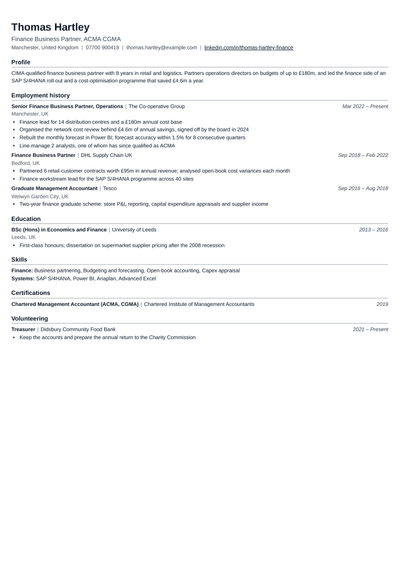
One-page resume templates that say everything that matters
Templates designed to fit your best work on a single page. Recruiters read the whole thing, your strongest results stay in view, and you never have to wonder whether page two got read.
A one-page resume fits your contact details, summary, experience, education and skills on a single page, with nothing spilling over. It is the standard for students, freshers and anyone with under five years of experience, and a strong choice for many mid-career professionals too. The point is not to squeeze everything in. It is to choose the work that best proves you can do the job you want next, and leave the rest out.
Who should use a one-page resume?
Students, freshers and interns, almost always.
Professionals with under five years of experience.
Career changers, where only the relevant parts of your history matter.
Anyone applying to startups, tech companies and consulting firms, where a tight page is the norm.
Senior leaders, academics and doctors often need more space. For them, the two-page Harvard template or the Academic CV is a better fit.
Pros and cons of a one-page resume
Pro: the recruiter reads all of it, so nothing important gets missed on page two.
Pro: it forces you to cut weak lines, which makes the strong ones stand out.
Pro: easier to tailor for each job, because there is less to change.
Con: long careers can feel cramped, and older roles get very little space.
Con: some roles, such as research and government jobs, expect more detail.
What sections should a one-page resume include?
Core sections: contact details, a two or three line summary, experience (or projects for freshers), education and skills.
Add only when relevant: certifications the job asks for, a one-line awards section, languages for international roles and a links line for portfolios or GitHub.
How to fit your resume on one page
Cut roles older than ten years or shrink them to one line each.
Keep three to five bullets for your latest role and one or two for earlier ones.
Rewrite long bullets so they fit on two lines: verb, what you did, result.
Drop what the recruiter assumes: "References available on request", school marks once you have a degree, and basic tools like email.
Group skills on one or two lines instead of a long list.
Try a two-column template if you have many skills or certifications.
Avoid shrinking the font below 10 points or the margins below half an inch. A page that is hard to read defeats the purpose.
How to format a one-page resume
Font: 10 to 11 points for body text, 14 to 18 points for your name.
Margins: half an inch to three quarters of an inch.
Header: name and contact details on two lines at most.
Spacing: a small, even gap between sections, and no blank lines inside a role.
Education: one line per degree once you have work experience.
One page or two pages: how to decide
Ask one question: does the second page hold anything the recruiter for this job needs to know? If it holds old roles, a long skills list or details already covered, cut it to one page. If it holds recent leadership results, publications or licences the job requires, two pages are justified. Never let a resume run onto a second page by a few lines. Either tighten it to one page or fill two properly.
A one-page resume, section by section
Here is how a made-up marketing executive with three years of experience, Aditi Shah, fits her work on one page: a header on two lines; a two-line summary naming her best campaign result; two roles with four and three bullets, each with a number; a skills block of eight tools in two rows; and her MBA on a single line. Older internships and school details are gone, and nothing she cut would have changed a recruiter's decision.
One-page resume examples
Fresher: headline, two-line summary, education with CGPA, three projects, one internship, skills and one certification.
Four years of experience: summary, two roles with four and three bullets, education on one line, skills grouped by type.
Career changer: summary naming the new field, a short skills section, the two most relevant roles and a recent course or project.
Technical role: skills sidebar, experience and projects in the main column, links to GitHub or a portfolio.
Are one-page resume templates ATS-friendly?
Page count does not affect how tracking software reads a resume. Layout does. The one-column templates here are the safest, and most two-column ones read well too. Bold, Brand and Graphic Designer are built for portfolio-led roles and are not marked ATS-safe. Whichever you pick, run it through the ATS resume checker before you apply.
Which one-page template should you choose?
Fresher: your first job, with education and projects first.
LaTeX Classic: the densest one-page layout, popular in tech.
Yes if you are a student, a fresher or have under five years of experience. With more experience, two pages are fine as long as every line is relevant.
Is a one-page resume enough for experienced professionals?+
Often, yes. Many professionals with five to ten years of experience fit their strongest work on one page by shortening older roles. Senior leaders usually need two.
What should I remove to fit my resume on one page?+
Roles older than ten years, school details once you have a degree, unrelated hobbies, references and any bullet without a result.
Do recruiters prefer one-page resumes?+
For early-career roles, most do, because a recruiter's first scan is short. For senior roles, they care more about relevance than length.
What is the smallest font I can use?+
Keep body text at 10 points or above, and margins at half an inch or more. If it still does not fit, cut content instead.
Is a one-page resume ATS-friendly?+
Length does not matter to tracking software. A one-column layout with standard headings and real text reads best.
Can a one-page resume have two columns?+
Yes. Two columns are one of the easiest ways to fit more on one page, by moving skills, links and certifications into a narrow sidebar.
Is a CV one page too?+
It depends on the country. UK CVs are often two pages, and academic CVs can run much longer. Check the country or field format before you decide.
Fit your best work on one page and land the interview
Pick a one-page template, add your details or upload your old resume, and check your ATS score before you apply.