Fresher resume formats that help you land your first job
Resume templates built for freshers and final-year students. They put your education, projects and internships first, so recruiters see what you can do even before you have work experience.
When you have no full-time experience, a recruiter is trying to answer one question: can this person learn the job quickly? Your resume answers it with proof. Good grades help, but projects, internships, competitions and the tools you have actually used say far more. A fresher resume works when every line shows something you did, not just something you studied.
How to write a fresher resume, step by step
Pick one target role. A resume aimed at "any job" convinces nobody.
Collect your proof. List every project, internship, competition, certification and club role, with one result for each.
Choose a one-page, one-column template with education and projects near the top.
Write a two-line summary naming the role and your strongest proof.
Keep your best three projects and write each like a job: what you built, with what, and the result.
Match the job post by using its words for skills you really have.
Check it for typos, one-page fit and your ATS score before you apply.
Which resume format is best for freshers?
There are three common formats. Reverse-chronological lists your most recent education and experience first, and it is what most recruiters and tracking systems expect. Functional groups your skills and hides dates, which recruiters often read as hiding something. Combination puts a short skills section on top, followed by education and projects in date order. For most freshers, reverse-chronological or a light combination works best.
What order should the sections go in?
Put your strongest material at the top. For most freshers that means this order:
Contact details and a one-line headline, such as "Final-year B.Tech, Computer Science".
A two-line summary that names the role you want and your best proof point.
Education, with your degree, college, year and CGPA or percentage.
Projects and internships, each with what you built and the result.
Skills, grouped by type (languages, tools, frameworks).
Certifications, achievements and positions of responsibility.
The Fresher template follows this order by default, so you only need to fill it in.
How to write projects like work experience
Most freshers list a project title and stop there. Instead, write two or three bullets for each project the way you would for a job: what you built, which tools you used and what changed because of it. "Built a college event app in Flutter used by 1,200 students during the fest" tells a recruiter far more than "Event management app". Numbers make a line believable, even small ones like users, accuracy, time saved or marks.
Fresher resume samples by stream
Computer science or IT: lead with projects and GitHub, then internships and a skills block of languages, frameworks and tools.
Mechanical, civil or electrical: final-year project, industrial training or plant visits, and design software such as AutoCAD or MATLAB.
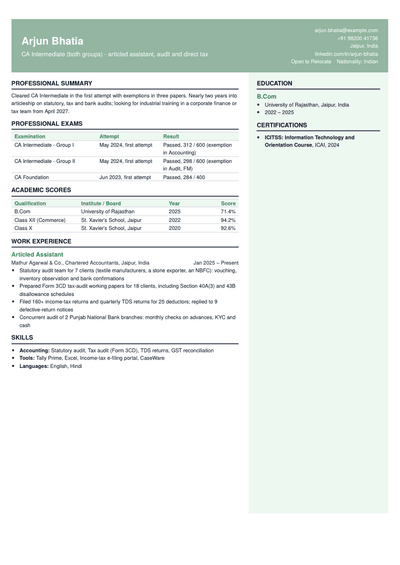
B.Com or BBA: accounting software, Excel, internships at firms, and any finance or sales competitions.
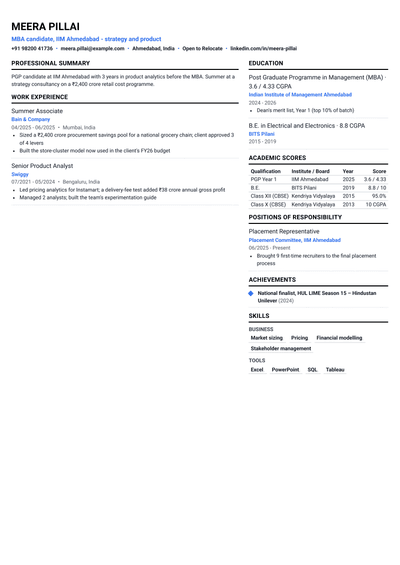
MBA: summer internship results first, then live projects, case competitions and positions of responsibility.
Arts, media or teaching: writing samples, teaching practice, events organised and a portfolio link.
Keep it to one page
A fresher resume should fit on a single page. Cut school-level details once you have a degree, drop hobbies that say nothing about the job, and remove an objective statement that only repeats the job title. If you are still short of space, keep your best three projects and move the rest to your GitHub or portfolio link.
How to match your resume to each job
Large companies and campus drives screen resumes with applicant tracking systems before a person sees them. Read the job description, note the skills it asks for and make sure the ones you really have appear in your skills and project bullets, using the same words. Avoid photos, text inside images and tables, which some systems cannot read, or start from one of the ATS-friendly resume templates. Before you apply, run your resume through the ATS resume checker so you know what the software sees.
Campus placement or off-campus applications
For campus drives, follow the placement cell's format if it gives one, and check the CGPA cutoff before you list your score. Off campus, on job sites, LinkedIn or company career pages, your resume competes with hundreds of others inside a tracking system, so keywords from the job post matter more. Keep one master resume with every project and skill, then save a shorter, tailored copy for each role.
Which mistakes do freshers make most often?
Listing every subject studied. Pick four to six courses that match the job and leave the rest out.
Soft skills with no proof. "Good communication" means little on its own. Show it instead: "Presented our capstone project to a panel of 5 industry judges".
Personal details nobody asked for. Date of birth, father's name, religion and a declaration line at the bottom take space and add nothing for most private employers.
An email address from school days. Use a simple one with your name, and add a LinkedIn or GitHub link if it shows real work.
Typos. One spelling mistake can end a fresher application. Read your resume out loud before you send it.
Which skills make a fresher stand out?
Recruiters hiring freshers look for proof that you can use real tools, not just name them. For tech roles that means languages and frameworks you have shipped something with. For business roles it means Excel, data tools and presentation work you can show. Certifications help most when they come with a project that used the skill, so link the two wherever you can.
Which fresher resume template should you choose?
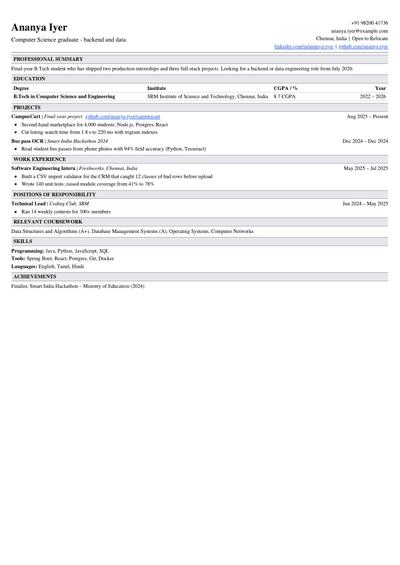
College Student: for students still in college, with room for coursework, activities and leadership roles.
LaTeX Classic: the dense one-page look engineering and tech students prefer, without needing to write LaTeX code.
Internship: for internship applications, with relevant coursework and projects close to the top.
Fresher: a clean, friendly layout for your first full-time job in any field.
Whichever you pick, you can switch later without retyping anything, so start with the one that feels closest to the jobs you are applying for.
A one-page, single-column resume that lists education and projects before work experience. It shows your potential first and is easy for applicant tracking systems to read.
Should a fresher resume have an objective or a summary?+
Use a short summary of two lines that names the role you want and your strongest proof, such as a project or internship result. A generic objective like "seeking a challenging role" wastes space.
Should I include my CGPA or percentage?+
Yes, if it meets the cutoff the company mentions, which campus drives usually state as a minimum CGPA or percentage. Put it on the same line as your degree. If it is below the cutoff, leave it out and let your projects do the talking.
How long should a fresher resume be?+
One page. A recruiter's first scan is quick, and a single focused page with your best projects is stronger than two pages of filler.
What if I have no projects or internships?+
Use your final-year project, course assignments, hackathons, volunteering or a club role. Describe what you did and what came out of it. Even a small personal project you can link to is better than an empty section.
Should I add a photo to my fresher resume?+
No, unless the employer asks for one. Most private companies in India and abroad do not need a photo, it takes space from your projects, and some tracking systems cannot read it. Use that space to show what you can do.
Should I mention my 10th and 12th marks?+
Only when the employer or campus drive asks for them, which many placement drives do. Then add one short line each under your degree. If the job post does not ask, leave them out and use the space for projects and skills.
Are these fresher templates ATS-friendly?+
Yes. Every template on this page uses standard headings and real text that tracking systems can read. A few use two columns, so if you apply mostly through online forms at large companies, pick a single-column one such as Fresher or College Student.
Land your first job with a resume that shows your potential
Pick a fresher template, add your details and check your ATS score before you apply.